Campaign World Awaits Supreme Court Ruling on Spending Limits
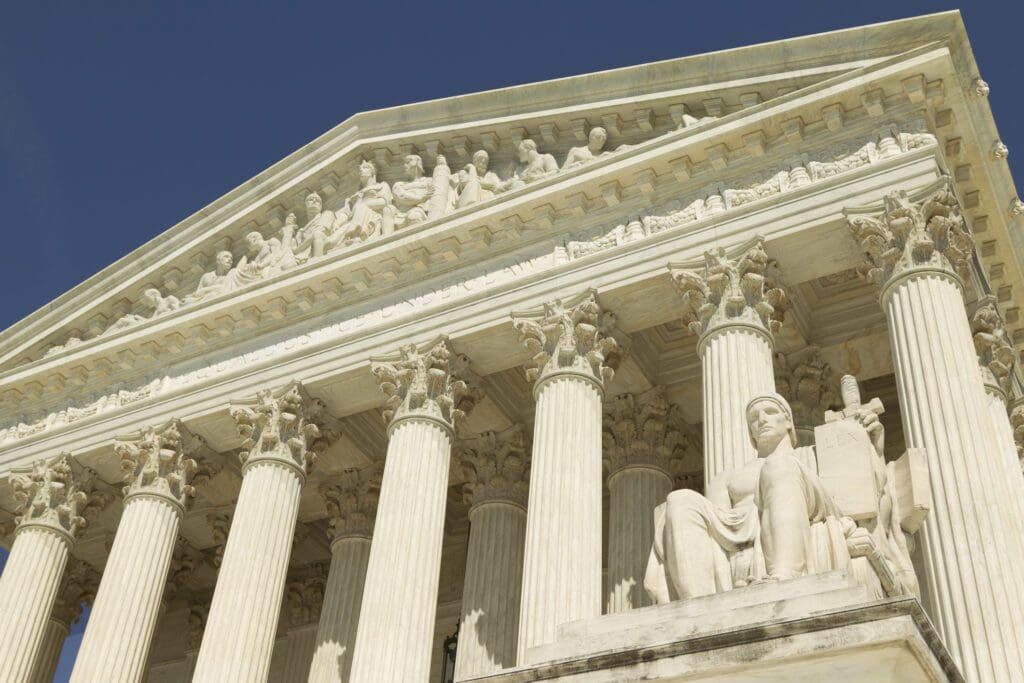
The Supreme Court gave little indication on Tuesday of whether it’s willing to strike down 50-year-old limits on how much political parties can spend in coordination with candidates, leaving the campaign world waiting with bated breath.
The court heard arguments in National Republican Senatorial Committee v. Federal Election Commission, which challenges existing limits on coordinated party expenditures. If the justices ultimately decide to strike down those limits, it could unleash a new torrent of money into elections across the country and give party committees access to cheaper advertising rates reserved for political candidates.
A decision on the case is expected by July. Until then, the political world is searching for any hints as to what side the court will come down on.
“You couldn’t read the tea leaves,” said Rachel Jacobs, a partner at Elias Law Group who also serves as general counsel to the Democratic Congressional Campaign Committee. “It’s really hard to know.”
Jacobs, who was in the courtroom on Tuesday, said she felt that the oral arguments went “as well as it could have” for the Democratic groups that intervened in the case in an effort to uphold the existing coordinated party expenditure limits. But she also acknowledged the staunch conservative tilt of the Supreme Court and noted that some justices were relatively muted in their questioning.
Justice Neil Gorsuch, a conservative nominated to the court by President Donald Trump, did not speak at all, while another conservative, Justice Amy Coney Barrett spoke only once.
The case could unfold in a few different ways. The justices could uphold the federal limits on coordinated spending, as the court did in 2001 in a case brought by Colorado Republicans, or decline to rule on the case for procedural reasons – an outcome that Jacobs said doesn’t appear likely, given the justices’ interest in the merits of the arguments.
The court could also side with the NRSC and Republicans and strike down the coordinated spending limits – a move that would amount to one of the biggest changes in campaign finance law since the Supreme Court struck down legal limits on independent political spending by corporations and unions in Citizens United v. FEC in 2010.
“It would be a fundamental change to the campaign finance system as we know it,” Jacobs told Campaigns & Elections. “Basically, what this would allow is for the national committees to bankroll campaigns that don’t raise money or can’t raise money for whatever reason.”
The legal challenge to the coordinated spending limits was first brought in 2022 by Vice President and then–Senate candidate JD Vance and Republican groups. At the time, the Biden administration defended the existing restrictions. Once Trump took office, the federal government changed sides in the case, siding with the NRSC against the spending limits.
Republicans argue that the current limitations on coordinated party expenditures amount to an unconstitutional restriction on free speech. In Tuesday’s arguments, Deputy Solicitor General Sarah Harris, who argued the Trump administration’s case against the spending limits, urged the justices to “allow the First Amendment to do its work” by doing away with the restrictions.
In a statement, the NRSC’s General Counsel Blake Murphey insisted that “restricting a party committee’s ability to support its own candidates is unconstitutional and a direct violation of the First Amendment.”
“We’re grateful for the Court’s consideration and confident the Justices will rule in favor of protecting freedom of speech and association,” Murphy said.
Lifting the spending limits would almost certainly boost Republicans, who have largely trailed Democrats in winning small-dollar contributions. If the court moves to allow unlimited spending by political parties in coordination with candidates, the decision could allow parties to spend massive amounts of money from large donors directly on individual candidates.
In a joint statement, Democratic Senatorial Campaign Committee Chair Kirsten Gillibrand (D-N.Y.), Democratic National Committee Chair Ken Martin and DCCC Chair Suzan DelBene (D-Wash.) accused Republicans of working to “erode” longstanding campaign finance regulations and “further empower billionaire donors” to influence the country’s elections.
“We will continue standing strong against this blatant effort by Republicans to rig our elections,” the chairs said. “Free and fair elections are at stake, and Democrats will never stop fighting for the American people.”
Striking down the spending limits could have another impact on money in politics: giving party committees access to cheaper ad rates. Federal law requires broadcasters to offer lower ad rates to candidates, but not super PACs. By allowing unlimited coordinated spending between the parties and their candidates, however, the parties would suddenly be able to take advantage of those discounted rates.