
The Campaign Industry’s Tipping Point

In June 2008 a single decision altered the trajectory of American politics.
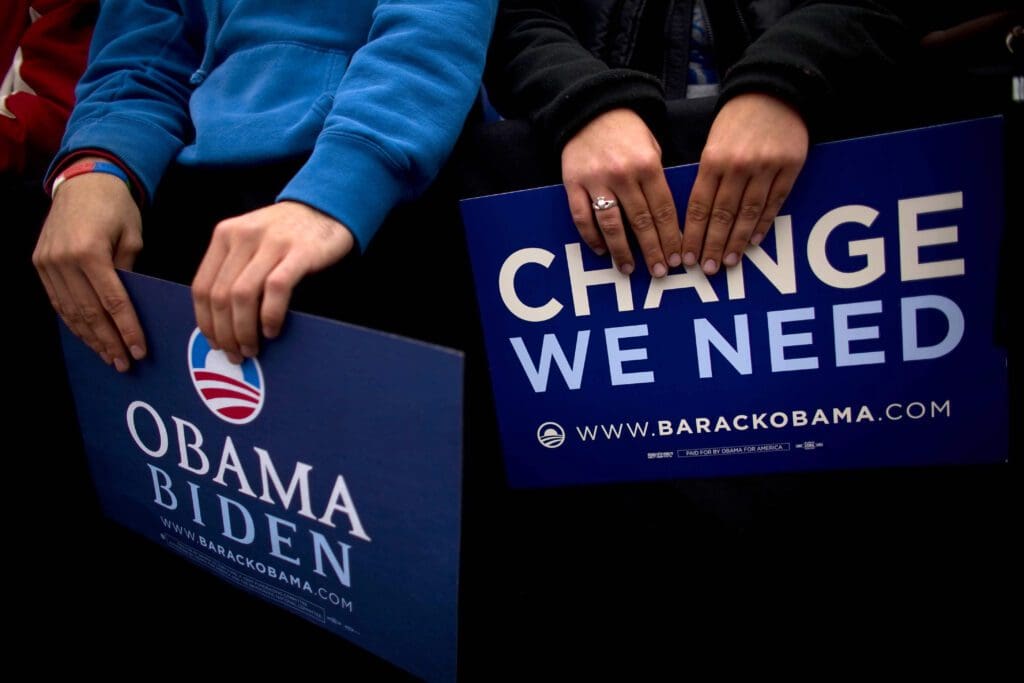
Then-Sen. Barack Obama’s campaign broke precedent—and a public pledge—by rejecting the presidential public financing system. By opting out of this structure and subsequently winning the 2008 election, the Democratic Party had available to them the resources and leadership to build the foundation of a more robust, activist-driven ecosystem, both in the field and through online giving.
It would take Republicans four years to match this structural shift within its ranks, because the only entity capable of driving that top-line change was a presidential campaign.
The Obama campaign’s decision catalyzed the transformation of politics into a professionally run, technologically powered and financially scalable industry. It marked the moment when campaigns evolved from short-lived, broadcast-television-focused efforts into durable, well-capitalized operations.
That shift didn’t happen overnight, and it didn’t affect both parties equally at first. But it set the stage for what came next: the rise of data-driven digital fundraising and the birth of a new class of political companies—firms that could raise capital, recruit talent and even go public.
The numbers speak volumes. In 2010, total federal campaign spending stood at $3.6 billion. By 2020, it had grown to $14.4 billion—a 300-percent increase in a decade, driven largely by digital media and fundraising. In 2014, digital represented just 11 percent of political money raised. By 2020, more than $7 billion was raised online – a 15-fold increase in just six years.

Four years later, in 2024, spending exceeded $30 billion across all federal and non-federal races. These aren’t just campaign budgets anymore—they’re scaled operations with sophisticated marketing tech stacks and investor-grade growth models.
This evolution wasn’t theoretical for us—it was personal. In the wake of Obama’s structural innovation and the digital explosion that followed, three friends recognized that politics was no longer just about passion—it was a sector ready for professionalization. We built a company that treated political communication and targeting with the same seriousness that Fortune 500 companies treated their customers with. We believed politics would require full-time professionals and resources.
And we built accordingly—with scale, structure and strategy. Our firm, Targeted Victory, now finds itself as an integral part of the publicly traded holding company Stagwell (STGW). We have 250-plus employees, we’ve raised some $2 billion for clients in the last decade and have recorded victories in all 50 states.
Now, we stand at the edge of another tectonic shift: the AI era.
Artificial intelligence will redefine political campaigns in ways even more transformative than the digital wave of the past decade. If the 2010s were about building email lists and optimizing Facebook ads, the 2020s will be about large language models, predictive analytics and real-time voter personalization.
AI is already enabling campaigns to analyze and react to vast amounts of data—demographics, behavioral patterns, donation histories—with unprecedented speed and precision. Instead of static personas or blunt segmentation, campaigns can now create fluid, AI-generated narratives tailored to individual voters in real time. It allows for streamlining ad buying, improving media planning, enhancing donor targeting and assisting rapid-response war rooms. For campaigns operating under immense pressure and limited timelines, these productivity gains are not just valuable—they’re game-changing.
Voters today are overloaded with information and wary of political noise. Done well, AI will allow campaigns to reduce friction and improve relevance, delivering messages people actually want to hear, when and how they want to hear them.
Some will see all of this change and be fearful of the future, but I believe that’s the wrong mindset. What defines great campaign staff is their ability to constantly arbitrage opportunities. They need to look at AI as the next enhancement that can help them be great at their jobs. As Nvidia CEO Jensen Huang recently said: “It’s not likely that you’ll lose a job to AI. You’re going to lose the job to someone who uses AI.” I would encourage those in our industry to really think about this statement and how they approach campaigns in 2026 and beyond.
Even with all these new technology offerings, it’s important that we don’t forget that all of these changes enhance the power and importance of the candidate. Personal story matters more than political pedigree, and no amount of audience segmentation and data science will save a candidate that has nothing to say.
What started in 2008 with a decision to reject limits has evolved into a full-fledged industry, although now it’s an AI-powered one. Campaigns are no longer seasonal sprints. They’re complex, data-rich enterprises. And in this transformation lies enormous opportunity to elevate the voter experience, expand participation and empower citizens with smarter, more meaningful political engagement.
Politics may have been professionalized over the last 15 years, but we’re still only just at the beginning of what’s to come.
Zac Moffatt is the CEO of Targeted Victory and the former Digital Director for Mitt Romney’s 2012 presidential campaign.