Three Supreme Court Cases That Could Reshape Politics in 2026
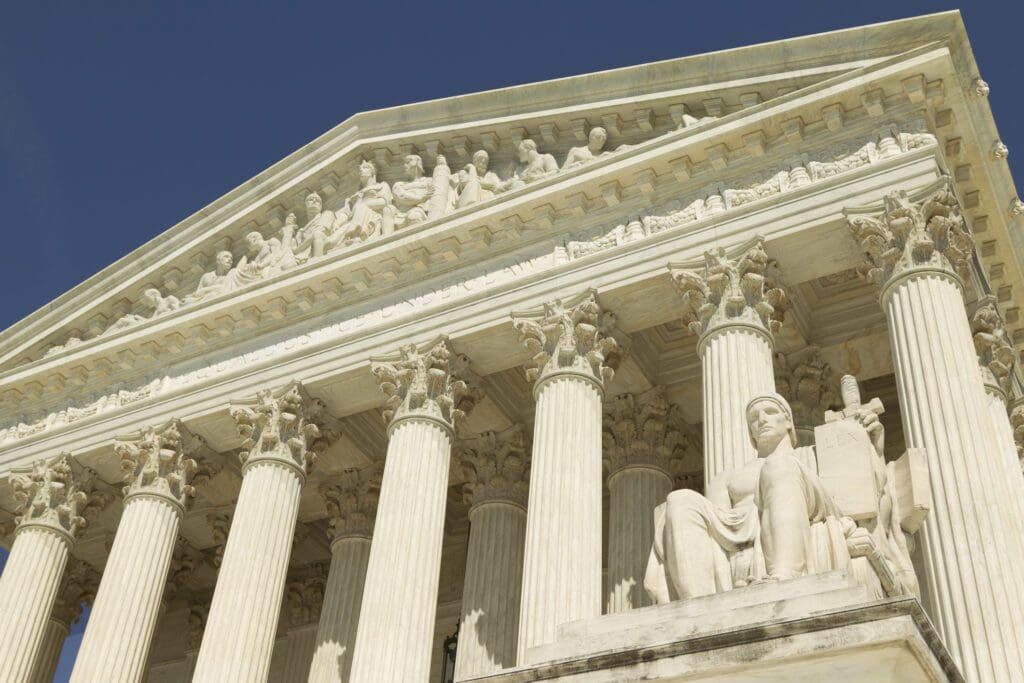
The Supreme Court is weighing a handful of cases that could have major impacts on political campaigns and elections in 2026 and beyond.
From considerations regarding the 1965 Voting Rights Act to questions about the constitutionality of federal limits on coordinated party expenditures, here’s a look at three cases that the political world is watching this year:
Louisiana v. Callais
Louisiana v. Callais centers on the state’s adoption of a second majority-Black congressional district that challengers say amounts to an unconstitutional racial gerrymander.
But the case also has wide-ranging ramifications for the Voting Rights Act. Louisiana’s current congressional map was created in response to another federal court ruling that the state’s previous map, which featured only one majority-Black district, likely violated the 1965 civil rights law.
If the justices come down on the side of the challengers, their decision could weaken the Voting Rights Act and pave the way for other states to redraw their congressional maps by doing away with or diluting the power of Black- and Hispanic-majority districts.
During oral arguments in the case last fall, the court’s conservative justices appeared skeptical of a provision in the Voting Rights Act that outlaws racial discrimination in elections and has been used as the basis for drawing majority-minority congressional districts.
A decision from the court could come as early as Friday, though court watchers say that a ruling is more likely in June.
NRSC v. FEC
National Republican Senatorial Committee v. Federal Election Commission could have the most sweeping effects on the mechanics of political campaigns, depending on how the justices rule.
The case centers on a challenge to long-established limits on how much political parties can spend in coordination with candidates, with the NRSC arguing that the existing caps on coordinated party expenditures amount to an unconstitutional restriction on free speech.
The challenge to the spending limits was first brought in 2022 by Vice President and then–Senate candidate JD Vance and Republican groups. At the time, the Biden administration defended the existing restrictions. But after Trump took office, the federal government switched sides in the case, leaving Democratic groups to defend the current law in court.
A decision in favor of Republicans could unleash a torrent of money into elections across the country. Democrats argue that if the spending limits are overturned, large donors could effectively fund entire campaigns on their own.
Lifting the existing coordinated spending limits could also give party committees and super PACs access to cheaper ad rates, allowing them to take advantage of the discounted rates currently reserved for candidates.
The justices heard arguments in the case last month, but offered few hints as to how they might come down. A decision on the case is expected by July.
Watson v. Republican National Committee
The key question here is whether laws that allow states to count mail-in ballots received after Election Day are constitutional.
The case revolves around a Mississippi law permitting mail-in ballots postmarked by Election Day but received up to five days later to be tabulated. The Republican National Committee, along with the Mississippi GOP and the state Libertarian Party, challenged the law in 2024, arguing that federal statutes establishing a single “election” day preempt Mississippi’s law.
In a brief to the justices, the challengers also argued that such state laws “reduce the time to resolve postelection disputes” and “deprive the electorate of a clear nationwide deadline.” Around 30 states and the District of Columbia accept some mail ballots that are postmarked by Election Day but received later, though the grace periods differ.
The Supreme Court agreed to hear the case in November, and oral arguments are expected in March.
Last fall, the justices also heard arguments in another case involving mail-in ballots. That case – Bost v. Illinois State Board of Elections – challenges an Illinois state law allowing mail-in votes received up to two weeks after Election Day to be counted. The court has yet to issue a ruling in that case.