Five Storylines for Campaigners to Watch in 2026
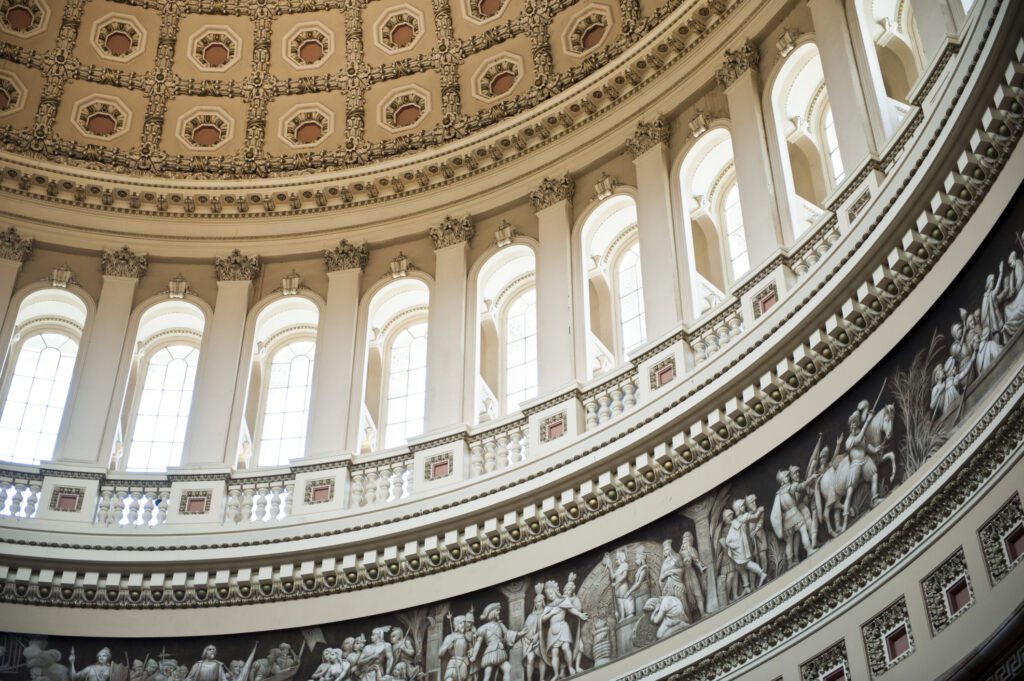
A detailed interior view of the US Capitol Building dome Washington DC
From the fast-growing use of artificial intelligence in political polling and advertising to the emergence of new digital fundraising platforms, 2026 is set to be a big year for disruption in politics.
Here are five storylines to watch in the new year:
The Future of AI Regulation
State governments have raced over the past couple of years to enact a slew of regulations to govern the use of artificial intelligence – from cracking down on deepfakes to requiring safety tests for AI models.
President Donald Trump threw a wrench in those efforts earlier this month, however, when he signed an executive order directing the Justice Department to sue states and overturn laws that it deems unsupportive of “United States’ global A.I. dominance.”
While the patchwork of state laws regulating AI has caused a compliance headache for many in the campaign industry, Trump’s executive order has also stirred confusion over which state laws the administration will actually target. How the Justice Department’s efforts play out is certain to be a defining storyline in 2026.
Digital Fundraising Drama
The digital fundraising world is rife with uncertainty heading into 2026.
The Justice Department has yet to release the findings of its months-long investigation into potential illegal contributions made through ActBlue, including so-called “straw” donations and foreign contributions, and it appears unlikely to do so before the new year.
Some progressive and Democratic groups have begun scouting out alternatives to ActBlue, fearing that the Trump administration could use its investigation into the online donation clearinghouse to hobble Democratic fundraising efforts.
On the right, meanwhile, the launch of the new online fundraising platform PSQ Impact this month threatens to trigger a clash with WinRed, the dominant grassroots fundraising platform in Republican politics.
The FEC Standstill
The Federal Election Commission is entering the new year at a standstill.
Since the beginning of 2025, the campaign finance watchdog has lost four of its six members to resignations and, in one case, a firing by Trump. That left the commission with just two members, Democrats Shana Broussard and Dara Lindenbaum, who are effectively powerless to conduct high-level business until Trump nominates and the Senate confirms at least two new members.
While some names for potential replacements have been floated in news reports, the White House hasn’t announced a timeline for nominating new FEC commissioners. Meanwhile, the commission is facing a growing backlog of enforcement matters.
The FEC is still handling routine business, like publishing quarterly campaign finance reports. But until the commission regains its quorum, it won’t be able to tend to important matters, like considering new rules and regulations.
The Affordability Debate
After a punishing 2024 election cycle, Democrats have begun to hone their messaging for 2026. Their focus: The cost of living in the U.S. is simply too high and Trump and Republicans are only making the problem worse.
The emphasis on affordability has already paid off. Democrats won a series of high-profile victories in off-year elections in Virginia and New Jersey, while democratic socialist Zohran Mamdani coasted to victory in the New York City mayor’s race on promises to take concrete action to tackle rising costs.
For his part, Trump has bounced between signaling that he’s willing to address the affordability issue head-on to dismissing it as a Democratic “hoax.” Still, the broader Republican ecosystem appears increasingly concerned about the cost of living and necessities like health care, and are pushing GOP leaders to take more immediate action.
Either way, the affordability debate is poised to shape massive parts of the 2026 election cycle.
The Future of State and Local Campaigns
The political world has seen a spate of new AI-powered products brought onto the market this year with the intention of professionalizing down-ballot campaigns by offering cheaper access to powerful political tools.
In some ways, these down-ballot races for state and local offices have emerged as proving grounds for AI’s use in campaigning. A report released last by the University of Texas at Austin’s Center for Media Engagement asserted that “local campaigns are currently more likely than national campaigns to use” generative AI, in no small part because larger federal and statewide campaigns tend to be more risk-averse.
Whether 2026 is the year that AI dominates in local elections, however, remains to be seen.