Kalshi Is Seeing a Record Amount of Trading On the Midterm. Will its Users Accurately Predict The ’26 Outcome?

Midterm campaign ad spending is set to eclipse the marketing outlay during the last presidential cycle. But that’s not the only financial record being set in 2026. Trading on prediction market Kalshi has already hit $800 million — surpassing the total of 2024.
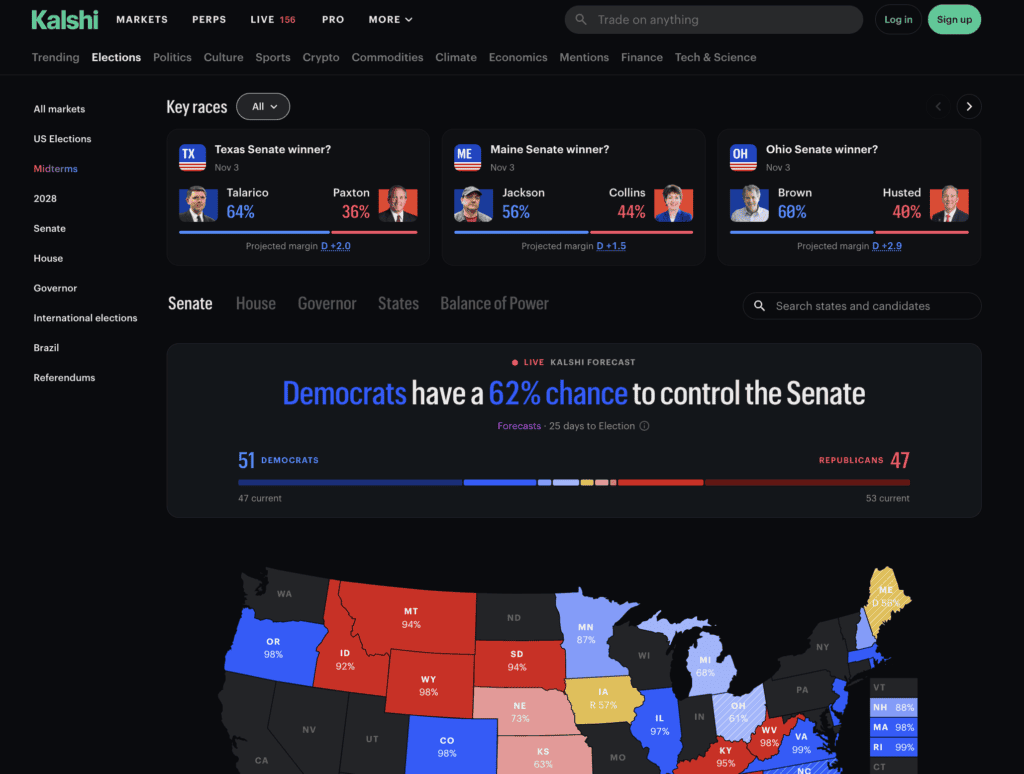
With that amount of trading volume, says Benjamin Freeman, who heads Politics Growth at Kalshi, “we have found that our market prices are pretty well calibrated — meaning that candidates with a 62-percent chance to win actually do win very close to 62 percent of the time.”
This makes Kalshi useful as a platform for reasons beyond just trading on potential outcomes. Campaign operatives (who can’t trade on their own races) can gauge their perceived chances of success given their current strategies, or donors can use it to help channel their contributions into races where their side has the highest probability of winning.
In fact, Kalshi has a 80-20 split between users who go to the platform simply for the information on its Midterm hub, which displays live chances for predictions like Democrats gaining control of the Senate, and users who engage in the prediction market.
“But it’s important to clarify, too, that if Kalshi has one candidate at 90 percent and one candidate at 10 percent going into Election Day, if that 10-percent candidate does actually win, that doesn’t necessarily mean we blew it.
“Similar to sports, upsets happen. So even with a well-calibrated forecast, that 10-percent candidate over a large sample size should actually win 10 percent of the time.”
Related
Rethinking Undecided Voters: Why Preference Isn’t Identity
As Kalshi has become a touchstone for candidate viability similar to public polling, there’s a concern that the chances of a candidate’s success could be manipulated by, say, a major donor spending big predicting their victory.
Freeman ruled that possibility out: “In terms of manipulation, we have a very robust surveillance team that is monitoring for this. If someone is engaging in market manipulation, we will refer them to our regulator, the CFTC, and take action against them.”
He also notes that Kalshi has strict insider trading prohibitions. “Candidates themselves can’t trade. Campaign staff can’t trade. People that are tallying votes can’t trade. Pollsters can’t trade. People that work at media organizations who are like calling these races or commenting on them can’t trade,” he said, adding that this list is non-exhaustive.
Still, even when large outlier trades are placed, they only temporarily move the market — similar to what happened during the Los Angeles mayoral primary earlier this year. “Someone placed a trade, which I think is our biggest election trade that we’ve ever seen — $1.25 million on Spencer Pratt to win,” Freeman said. “That one trade did move the price from $0.27 to $0.45, but it only took 9 seconds after for the price to go back down to $0.29.
“So even if someone’s trying to manipulate, because traders’ incentives are profit, they will correct those prices very quickly.”
Now, Kalshi currently offers trades on individual 2026 race outcomes, and larger predictions about control of the House or Senate by each party. Have an idea for a Kalshi market? You can email their team here or jump into their Discord chat and make a suggestion.
“With all of our market creation, we do that internally, but many of our best market ideas do actually come from our users and traders,” Freeman said.