The Sleeper 2026 Persuasion Tool: Telephone Town Halls

Even in what’s being characterized as a wave election year, margins will be incredibly tight. Control of the House, for instance, will be decided by fewer than 20 seats. In the Senate, it’s even slimmer. Don’t expect lots of blowouts down ballot either.
So how do you reach the small universe of voters who are on the fence? Curt Cerveny believes he has the right solution. As the President of Telephone Town Hall Meeting (TTHM), he’s helping clients use their data models to reach their target universes with content based on the issues they care about.
C&E: Tell us about how your clients are incorporating modeling into their town hall targeting.
Curt Cerveny: The top campaigns and groups are doing a really good modeling job using consultants who specialize in [statistical analysis of data to determine voter behavior]. Let me give you an example: we’ve got a PAC client in a state where they’re not supposed to coordinate yet.
So during their town halls, they ask: what are the topics or issues voters are interested in? From the data that they get, you can come up with 20 or 30 different topics if you do a good modeling job — all of which can be addressed in a follow-up telephone town hall later in the year. Essentially, you can give us the data and we develop an entire agenda for your target audience.
C&E: Telephone town halls had been considered an older technology because everyone has cellphones now. Is that still the case?
Related
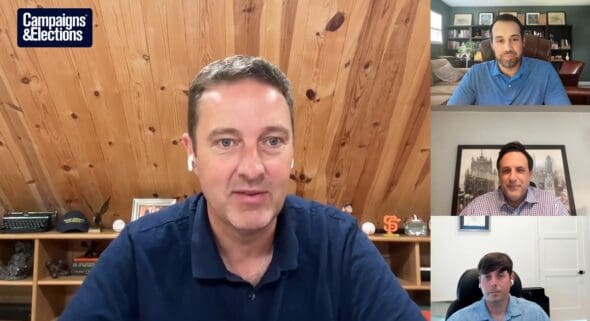
Cerveny: We call landlines and cellphones at the same time. We can call cellphones and we can bring them on with a live operator — that’s changed things.
C&E: Has it led to a revitalization of telephone town halls?
Cerveny: It certainly has, because it fits in perfectly with all this new modeling. As you see more and more campaigns and groups modeling, we see more interest because we’re a good outlet to make that valuable data actionable. We fit like a glove.
C&E: Can you give us another example of how modeling helps inform campaigns and groups’ outreach strategy?
Cerveny: It starts with maximizing efficiency. Let’s say you’re dealing with a congressional district that has 825,000 residents, not voters, but people in it. That file might have maybe 250,000 clean phone numbers. Boy, they better have done a good modeling job and boiled that down to the 100,000- 150,000 of the people they want to be talking to with regularity. You want to get likely voters and you want to reach those who have certain interests that align with the content of the event. We work with data partners who develop the models that make that happen.
C&E: There’s a certain profile of voter who turns out in the midterms. Is this an outreach tool to target, say, an older demographic?
Cerveny: Nowadays, when you’re doing a telephone town hall, almost 80 percent of all the people that pick up that phone are on a mobile phone. What does that mean? They’re not necessarily old people, they’re young people too, and they prefer to listen to it in their native language one way or the other.
C&E: Do you offer a translation service?
Cerveny: Yes, we do 12 different languages with Spanish obviously being the number one. The way it works is the call goes out, and when they answer, our operator says: ‘This is a call from so-and-so talking about X. Press 1 if you want to listen to it in Spanish.’
C&E: What other features can clients access?
Cerveny: We can send follow-up texts the morning after and ask the same polling questions addressed on the call. Do you want to volunteer? Or what’s the most important issue in this race? Or are you likely to vote? Not everybody stays on long enough to respond so the next morning we can pose those questions again via text. They’re very likely to respond because you reference that call they joined in the text message.
C&E: What kind of data do clients get from these calls?
Cerveny: After the event, they get an extensive package that is an Excel document that has all the information related to the call. How many people are on the call, how long they stayed, who pressed what button, who asked what question and when, the point of contact. And it also separates stuff for people that reported having serious issues that need to be addressed right away. Within an hour after the call, our clients have that information so can start addressing those concerns right away.
C&E: What’s going to move the needle with voters this cycle?
Cerveny: Issues targeted to that specific market. If it’s a local campaign or if it’s a statewide campaign, don’t talk about federal issues. Talk about state and local issues. That is unless the federal issues are overwhelming and you’ve got to talk about them. But ultimately, you drive the train based on the issues you want to cover, live with a professional moderator over the course of 45 minutes to an hour.