Listening Isn’t Optional


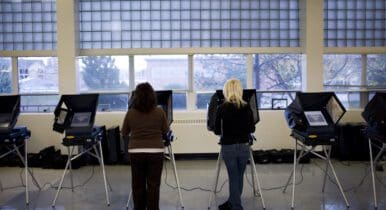
U.S. political advertising is on pace to top $11 billion for the first time in a non-presidential election cycle in 2026.
That number should prompt serious examination. For decades, much of political technology has too often optimized for reach before relationships—more impressions, more airtime, more donor lists. The result is a campaign ecosystem that has gotten extraordinarily expensive and oversaturated, but not necessarily more meaningfully connected to the people it claims to represent.
Look at Kentucky’s 4th Congressional District this spring. The Republican primary between Rep. Thomas Massie (R-Ky.) and challenger Ed Gallrein became the most expensive House primary in American history, with roughly $32 million spent as the race was pulled into a national fight over endorsements, outside groups, advertising and ideological loyalty.
Media reports can tell us which outside groups spent heavily, which endorsements mattered and which attacks broke through. But it is much harder to measure whether voters felt heard, whether their concerns were understood or whether the campaign conversation reflected the everyday pressures like inflation they were actually living with.
Money certainly plays a role in campaigns, and money is easier to measure than trust, understanding and representation. But when spending becomes the dominant scorecard, actual listening can get buried.
I ran for city council before building my political career. I lost by 11 votes, having organized the campaign with paper maps, a sprawling Google Sheet and a small army of neighborhood volunteers. Running that race taught me how much harder it is for someone without deep pockets or a modern campaign toolset to even compete.
Related
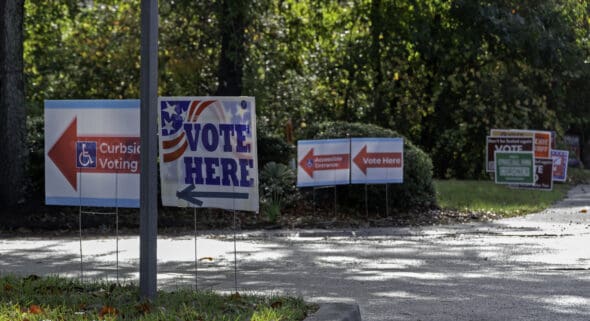
That barrier isn’t a feature of representative government. It’s a flaw in how political technology has been built: too much of the ecosystem has been built around the needs of the best-funded campaigns. Campaigns need both reach and relationships, but the industry has overfunded one and underbuilt the other.
American leaders who govern well have always understood something different: proximity to the people they serve isn’t optional.
Thomas Jefferson set an early precedent for direct public access to the presidency. After his 1801 inauguration, he personally received the citizens and dignitaries who came to greet him, and by his second inauguration in 1805, the walk back to the President’s House had turned into a procession any citizen could join. Jefferson’s face time with constituents showed Americans that access to power shouldn’t depend on connections or money. That same instinct shows up today in candidates who win, not by outspending their opponents, but by out-listening them.
In 2018, a 28-year-old first-time candidate took on the fourth-ranking Democrat in the U.S. House. Rep. Joe Crowley (D-N.Y.) pulled in more money from real estate interests alone–$347,000–than Alexandria Ocasio-Cortez raised for her entire campaign. She didn’t outraise him. She out-organized him, building a campaign around direct voter contact, block by block, instead of broadcasting her message. National coverage largely missed the story until the election was over, in part because fundraising had become one of the easiest proxies for viability. It shouldn’t be.
There’s already a proof of concept for listening infrastructure in Congress. Numerous congressional offices rely on constituent relationship management software built to track casework, route correspondence and make sure no constituent’s letter disappears into a void. It’s unglamorous, but it’s evidence that systematic listening works. Now, advancements in artificial intelligence are lowering the cost barriers to entry for candidates at the state and local levels.
The same logic has shown up in local government, too. In Chicago’s 49th Ward, residents were invited to help decide how a portion of local infrastructure dollars should be spent, weighing in on practical projects like streets, sidewalks, lighting and other neighborhood needs. The point was not ideology. It was structure; giving residents a clear, organized way to surface priorities and giving the government a way to act on them.
This is not a left or right argument. Conservative, moderate and progressive leaders all face the same basic test: whether they can stay close to the people they serve to understand what is actually happening in their lives.
That’s the through line. When a first-time candidate or a sitting official can centralize outreach, track constituent concerns and show up consistently for their community, the barriers to civic leadership start to fall. The question for this industry is whether we’re building for that future or coasting on the assumptions of the last one. Political technology’s next frontier isn’t only a more efficient way to broadcast.
What’s needed is a better infrastructure for listening at the district level–for the candidate without a PAC, the council member without a comms staff, the freshman lawmaker trying to keep up with casework from a district of hundreds of thousands of people. None of that requires massive money or insider connections. It requires treating constituent communication as the core discipline of representative government.
This is not an argument against advertising, digital strategy, fundraising or professional campaign support. Campaigns need all of those things. But they should sit on top of a deeper foundation: knowing who people are, what they care about, how they have been contacted and whether their concerns are actually making their way back into the work of representation.
Massive budgets and insider connections should not be the price of entry for effective civic leadership. Listening is still the job. Technology should be built to make that work easier and more consistent—not to replace it.
Becki Wright is Founder and CEO of Proximity, and a former campaign manager, fundraiser and consultant who has worked on campaigns up and down the ballot.