The Real Waste in Political Media Buying


Every cycle, someone makes the same argument: campaigns are wasting millions because their targeting isn’t precise enough. They’re activating the base and engaging non-voters, but overlooking persuadables.
The instinct is right, but the framing can get too narrow. It overlooks how political media actually works when you’re trying to move real budgets on a quick timeline.
In politics, no one wants to leave money on the table. If a campaign loses with budget left over, the real question isn’t why it didn’t spend more, it’s whether that unspent money could have persuaded more voters. That pressure shapes strategy in ways commercial advertisers often don’t face.
Yes, targeting matters, but it’s only the starting point. The harder challenge is staying targeted while scaling efficiently without spiking frequency, duplicating reach or buying less desired inventory.
If campaigns want to waste less in 2026, the edge will come from consolidating digital buying, treating reach and frequency as an operational discipline and using a waterfall strategy that scales beyond first-party lists.
Waste Comes From Linear Spill and Fragmented Buying
While linear cable and broadcast remain powerful tools for reaching voters at scale and are highly effective for broad reach, their impact is limited by both declining viewership and lack of precision in measurement. You can’t truly deduplicate reach in linear, and you can’t see exposure with the same clarity you get in programmatic. As a result, campaigns often waste impressions on people who are already being hit repeatedly.
Related
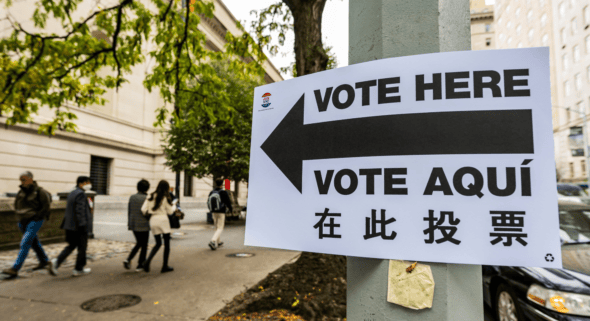
Geography makes the problem more challenging. Linear is bought on designated market areas, but political boundaries rarely line up neatly with them. A campaign may buy a DMA where most of the audience sits outside the district and only a small portion is actually relevant. That means a meaningful share of impressions lands outside the geography that matters.
On the digital side, waste often comes from fragmentation. Many political advertisers still buy direct from major publishers, while also running through a demand side platform. Once spend is spread across disconnected channels, reach and frequency become difficult to manage and overlap becomes hard to see.
That’s where the fragmented waste shows up – not just in reaching the wrong voters, but in unmanaged duplication across linear, direct publisher buys and programmatic delivery.
Start Targeted, Then Waterfall to Scale
Political consultants are right to resist making audience targeting the whole strategy. In this category, efficiency matters as much as precision.
It starts with inclusion, not exclusion. Begin with the audience most likely to contain swing voters, not people already committed to your candidate. But once that audience is saturated – once you can’t add scale without overserving the same people – you need a smarter way to expand.
That’s where a waterfall approach works. Start with your highest-priority audience – usually a first-party voter file or modeled equivalent – max out reach there without pushing frequency too far, then move to the next-best proxy for the same kind of voter, whether that’s high-attention news or live sports.
The advantage is optimizing reach and frequency across priority audiences. As you move down the waterfall, you stop spending on people already reached and shift budget toward adjacent audiences that are still likely to be persuadable.
That’s why “precision exclusion” is the wrong core idea. Exclusions still matter. Early voting and high linear viewers are the clearest examples, since there’s no reason to keep targeting someone who has already cast a ballot or is mainly watching broadcast and cable.
But at a broader level, the industry is moving toward smarter inclusion. Matching is imperfect either way. Inclusion does a better job of keeping campaigns focused on the voters they still need to reach.
Measure Reach and Frequency, Validate With Lift
In programmatic political advertising, the core KPIs are still reach and frequency. The goal is simple: maximize both across the target audience while controlling cost.
Programmatic matters because it gives campaigns visibility across inventory, channels, and environments. That flexibility allows them to start with a strong channel like connected TV against a first-party audience, then expand through other tactics until they reach voters wherever they are.
Because linear still absorbs so much spend, one of the most useful efficiency levers is incremental reach measurement. The principle is simple: don’t keep paying to reach people who are already saturated through linear. Use streaming and CTV to find the voters linear missed, so those channels complement broadcast instead of duplicating it.
Politics is ultimately judged by winning or losing, but campaigns still need directional signals along the way. A unified digital measurement strategy can complement traditional campaign polling that has long informed linear strategy. Features like brand lift and engagement lift identify trends in real time that can be immediately acted on within a unified platform strategy. When there’s no classic conversion event, lift-based measurement becomes a practical way to guide decisions.
In 2026, the campaigns that waste less won’t be the ones with the most intricate audience strategy. They’ll be the ones that treat consolidated digital buying, reach and frequency management and waterfall scaling as the strategy. Because in political advertising, efficient spending at scale isn’t a byproduct of the plan. It is the plan.
Mark Positano is the head of political at StackAdapt, a programmatic digital advertising buying platform.